
Discover practical closet organization ideas that make a small wardrobe easier to use, from daily-access zones and sliding gaps to wear-again storage, folding buffers, overflow boundaries, and quick wardrobe resets.
No matter how well you organize a closet, what often happens after a few days? Clothes tumble out when you open the door, you have to move three or four hangers just to retrieve one shirt, bags and shoes pile up on the floor, and the top shelves become difficult to reach. Before long, the closet feels packed.

But is the closet actually too small, or does it simply lack usable space?
It is important to distinguish between total storage capacity and usable storage capacity. Total capacity is the maximum amount a closet can hold. Usable capacity is the space you can actually access and use efficiently.
When getting to your daily clothes becomes a struggle, the problem is often the closet system rather than the amount of clothing. Filling every empty space with containers is not the answer. Good organization starts by designing the layout around your actual dressing routine.
These practical closet organization ideas focus on the problems that make small wardrobes frustrating: poor visibility, restricted movement, difficult access, complicated returns, and uncontrolled overflow. The goal is not to make your closet look perfect. It is to make it work better.
1. Create a “Daily Reach Zone” Instead of Organizing Everything Equally
Daily-wear clothes often get mixed with occasional pieces. During the morning routine, pulling out one item can disturb several others. At the same time, prime closet space is occupied by clothes you may wear only once or twice a month.
Create three access levels:
Daily → Weekly → Rarely Used
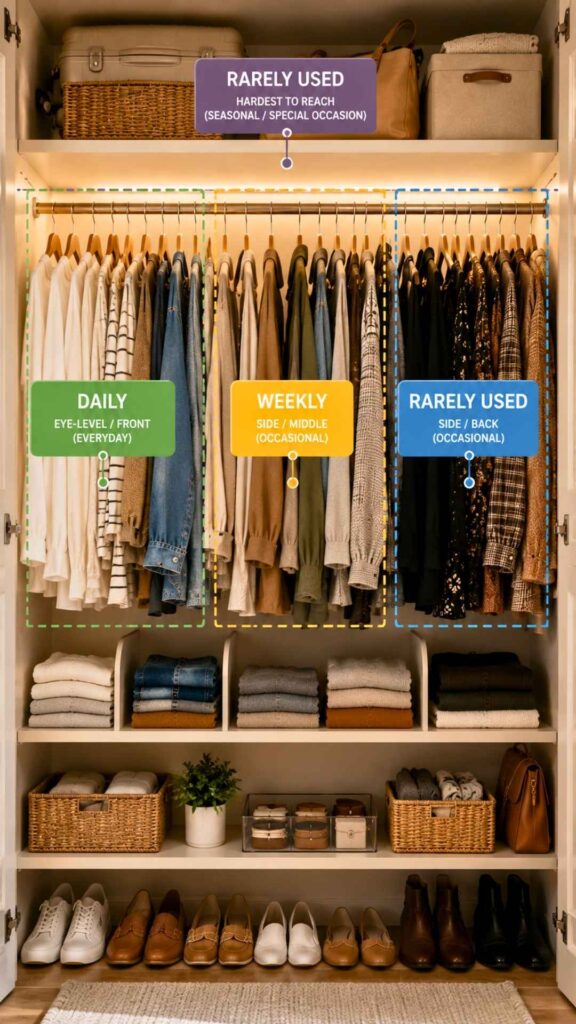
Keep daily-wear clothes at eye level and toward the front. Place weekly-use items farther to the side or slightly deeper, while rarely used, seasonal, or special-occasion clothing can go into upper or harder-to-reach areas.
Insight: Your closet should be organized according to how often you use something, not just what type of clothing it is.
Helpful accessories: shelf dividers, small front-facing garment sections, and removable shelf markers.
2. Stop Creating a Hanger Traffic Jam
A closet can technically hold all your clothes while still being difficult to use. When hangers are packed tightly together, they become difficult to slide along the rod. One garment blocks another, making the closet feel full even when there is still usable space.
The solution is to prioritize free movement, not maximum hanging capacity.
Group clothes according to how often you move them. Give frequently accessed sections a small sliding gap on the rod, and avoid filling the rod to its absolute capacity.
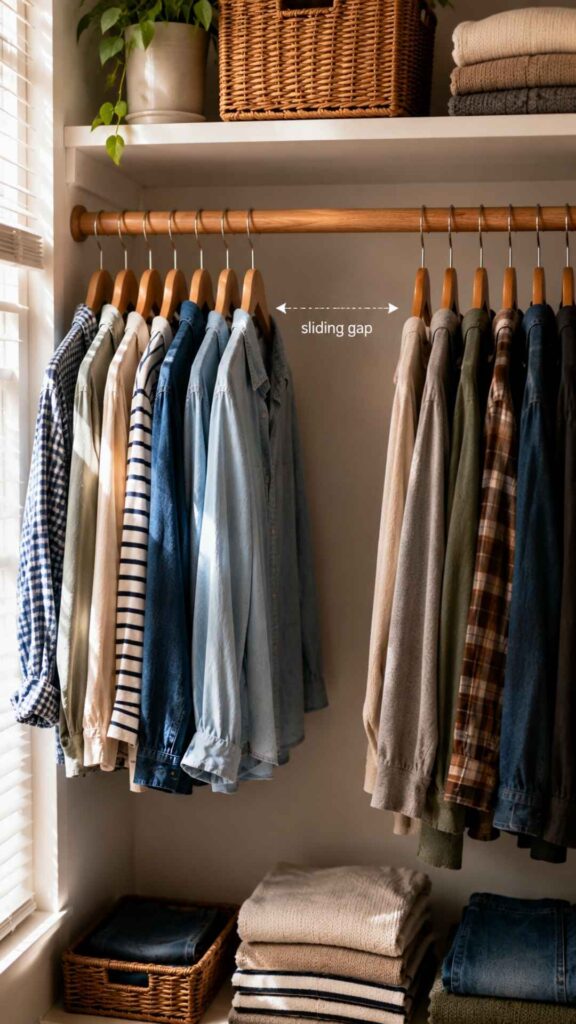
A rod that holds 25 garments comfortably and allows you to move them easily can be more useful than one crammed with 40 garments.
Helpful accessories: adjustable garment dividers and small rod separators.
These are especially useful closet organization ideas for small spaces, where every bit of movement matters.
3. Build a “Return Home” Spot for Clothes You Wore Once
Some clothes fall into an awkward middle ground. You wore them once, but they are not dirty enough for the laundry and do not feel ready to go straight back into the wardrobe.
Those pieces often end up on a chair, over the bed, or in a random part of the closet. That small habit can quickly create visible clutter.
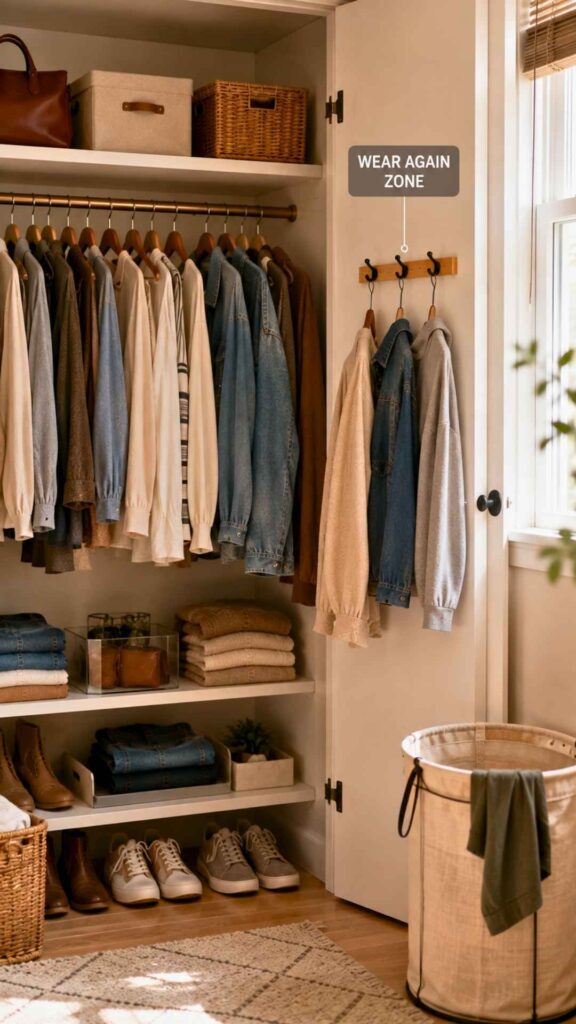
Instead, create a dedicated wear-again area with two or three hooks or hangers. You do not need a special rack or another piece of furniture. A small, clearly defined section is enough.
This is not clean-clothes storage or laundry storage. It is simply a temporary holding spot for clothes that can be worn again.
The benefit is straightforward: clothing no longer needs to compete with the closet, the laundry basket, or the bedroom chair.
4. Use a “Seasonal Parking Space” Instead of Reorganizing the Whole Closet
As seasons change, summer and winter clothing begin competing for the same space. Rarely worn items can occupy the best and most accessible parts of the closet, making everyday clothes harder to reach.
Instead of reorganizing the entire closet every few months, create a seasonal parking space.
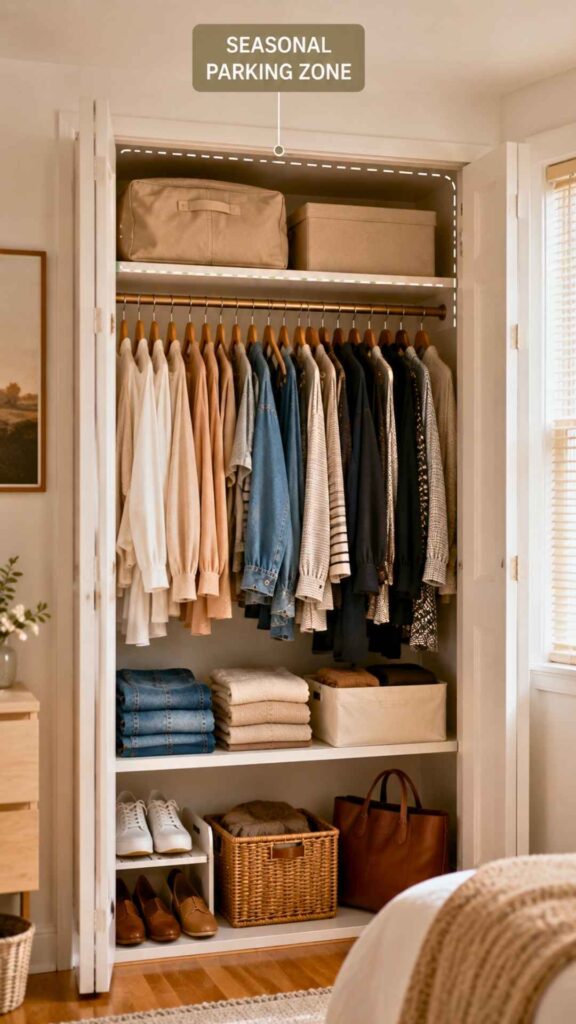
Depending on your home, this might be under-bed storage, a high cabinet, a seasonal storage box, or a soft storage bag.
The important part is to move only the seasonal layer rather than rebuilding the entire closet from scratch.
Helpful accessories: seasonal storage boxes, soft storage bags, and shelf-height containers.
5. Fix the “Dead Floor” Problem Without Adding Furniture
Shoes, handbags, and laundry baskets often compete for the same small patch of floor. Meanwhile, narrow strips, corners beneath hanging clothes, and other awkward footprints may sit unused.
Instead of adding another piece of furniture, identify the specific areas that are actually available and give each one a defined purpose.
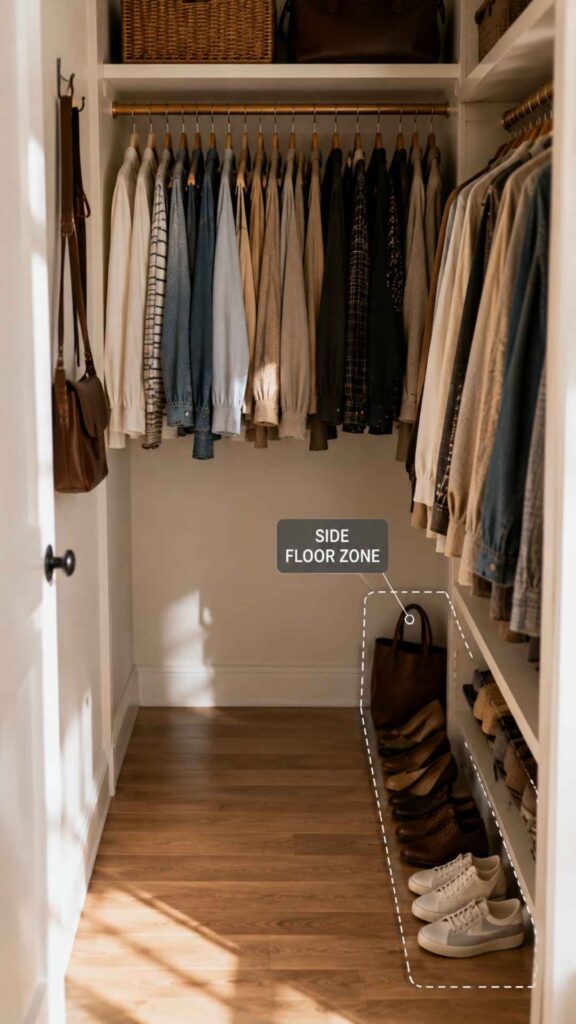
A narrow side section might hold shoes. A small corner might hold a handbag. Another area might be reserved for a laundry basket or folded accessories.
The goal is not to fill every inch of floor space. It is to stop belongings from spreading randomly across it.
This simple approach can make a closet feel more open without increasing its physical size.
6. Create a “Folding Buffer” for Clothes That Have No Drawer
After laundry is folded, the next problem is often the closet shelf. Tall stacks collapse, and removing one T-shirt can disturb everything around it.
Instead of building higher stacks, create shallow, stable groups.
Separate folded clothing by type and keep each stack low enough that removing one item does not bring down the rest. Shelf dividers and fabric compartments can make those sections easier to maintain.
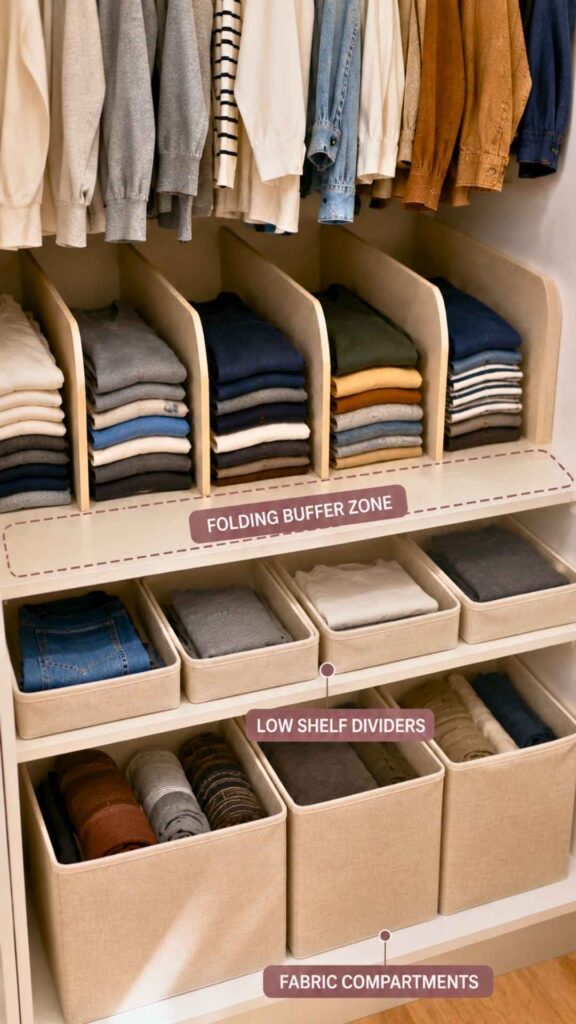
The key is to reduce stack depth and height rather than trying to fit as much clothing as possible into one pile.
Helpful accessories: low shelf dividers and fabric compartments.
For closet organization ideas for small spaces, this is especially useful because the solution improves access without requiring more furniture.
7. Give Bags Their Own “Shape-Safe” Storage
Handbags can create a surprising amount of clutter. They collapse when stacked, straps become tangled, and smaller bags can disappear behind larger ones.
Instead of stacking them, store frequently used bags upright. Use narrow dividers to keep each bag visible and in place. Softer bags can sometimes be stored inside one another when appropriate.
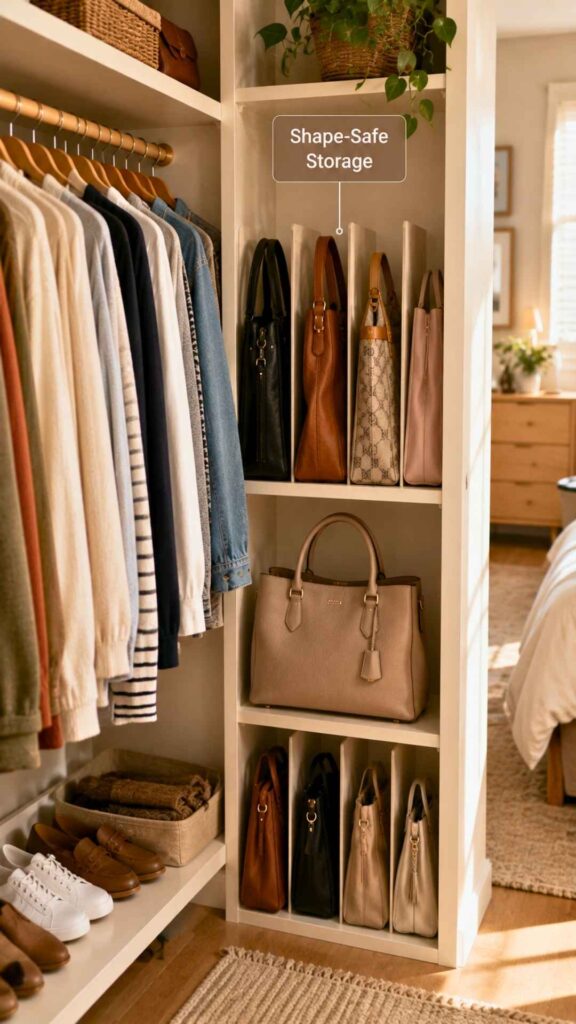
The important issue is not simply how much space the bags occupy. It is also whether their shape is preserved and whether you can see and reach them easily.
Helpful accessories: narrow bag dividers, upright handbag organizers, and shelf separators.
8. Create a “One-Hand Return” Zone
A storage system can look excellent at first and still fail after a few days. The reason is often simple: putting things back is too difficult.
When everyday storage requires opening lids, moving boxes, or rearranging other items, people naturally stop following the system.
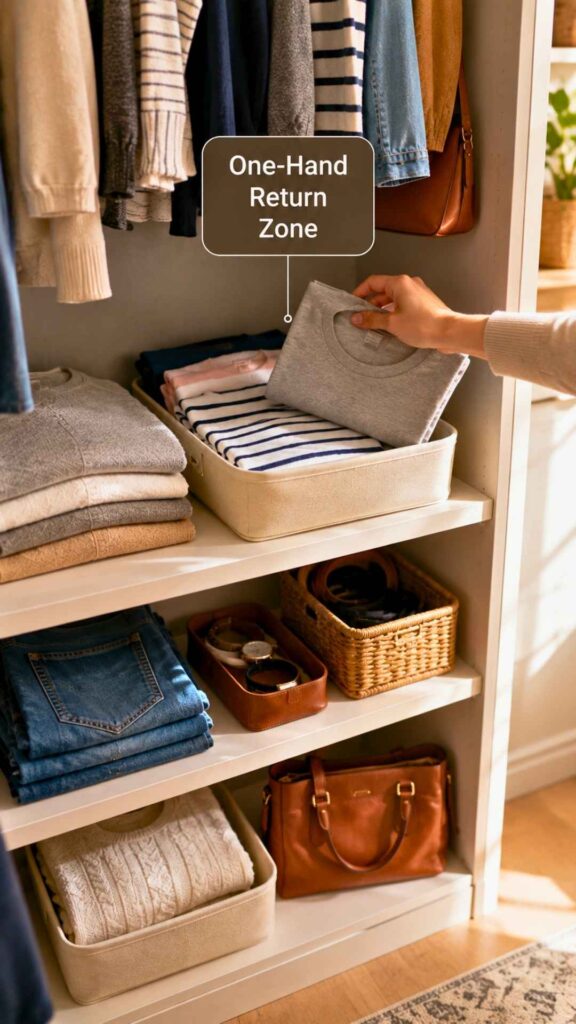
Create a one-hand return zone using open bins, open shelves, front-facing slots, or easily accessible hooks. Avoid complicated storage for things you use and return every day.
The rule is simple: returning an item should be easier than leaving it out.
Helpful accessories: open fabric bins, shallow baskets, and open shelf compartments.
Among these practical closet organization ideas, this may be one of the most important because it addresses why organization systems break down in real life.
9. Create an “Overflow Boundary” Before the Closet Overflows
New clothes can keep arriving even when the closet has already reached its practical limit. Eventually, the overflow moves onto the chair, the bed, or the floor.
Instead of waiting until the room is visibly cluttered, create a small overflow boundary inside the closet.
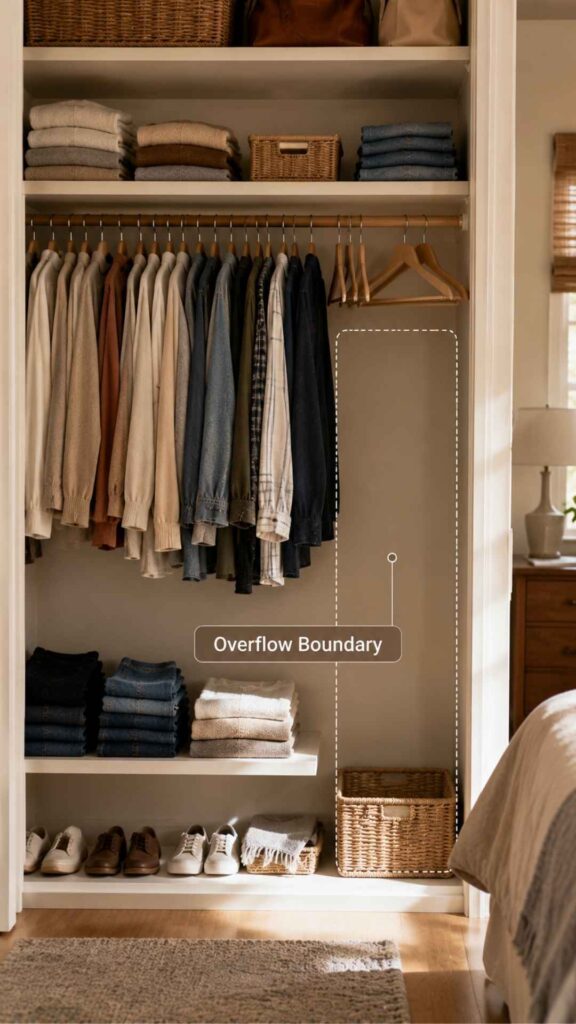
This could be an extra hanger, a small temporary basket, or a designated shelf section. Its purpose is not to store unlimited extras. It is to signal when the closet has reached capacity and something needs to be removed, relocated, or reassessed.
This turns organization into a way of managing capacity rather than simply adding more storage.
10. Do a “Wardrobe Reset,” Not a Full Closet Reorganization
The motivation to reorganize a closet can be strong at first, but maintaining a large system can become exhausting. Over time, the closet slowly returns to its old habits.
Instead of waiting for another major cleanup, use a short wardrobe reset.
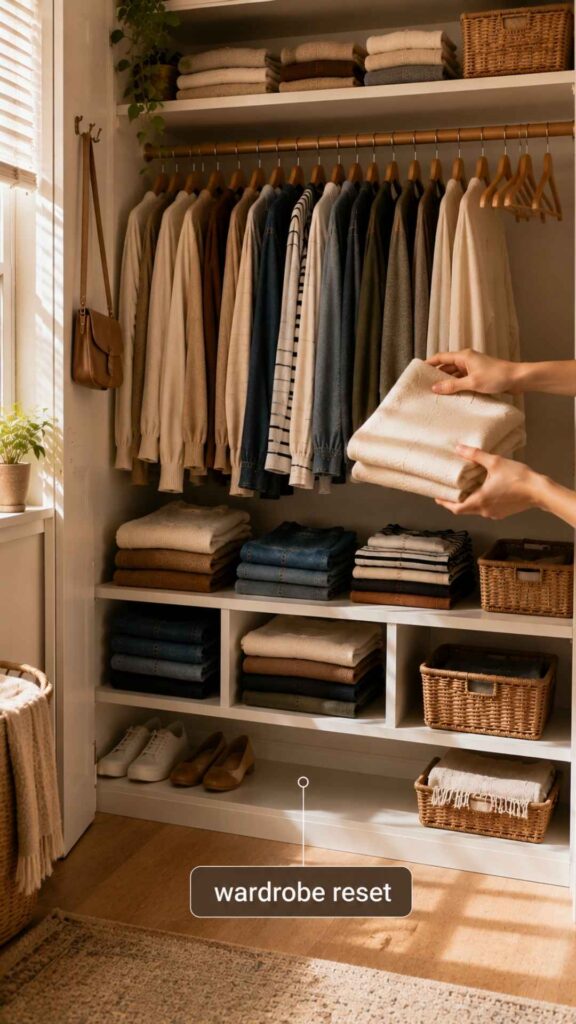
Step 1: Return misplaced items.
Step 2: Move seasonal items to their designated zones.
Step 3: Remove duplicates.
Step 4: Restore the daily-use area.
Step 5: Clear the floor.
Step 6: Fix one problem at a time.
The purpose is not to reorganize everything again. It is simply to return the closet to a usable state.
Quick Decision Guide
If your closet is overflowing even though you do not own that many clothes:
Fix the hanging and shelving arrangement.
If clothes keep piling up on a nearby chair:
Create a designated wear-again zone.
If seasonal clothes constantly take over:
Set up a dedicated seasonal storage area.
If folded stacks collapse when you pull out one item:
Reduce stack height and create a specific folding zone.
If your organization system works for only a week:
Make the return process easier and establish a quick reset routine.
If clutter keeps spilling into the bedroom:
Set a clear overflow boundary.
Instead of waiting months for a major cleanup, use a quick, regular wardrobe reset.
Final Thoughts
The best practical closet organization ideas do not try to force a tiny closet to function like a walk-in closet. That approach usually creates more frustration rather than solving the real problem.
Before buying more storage, look at how you actually use the closet during a normal week. Which clothes do you wear most often? Which items end up outside the closet? What is difficult to put back? Where do seasonal clothes go? What happens when the closet reaches capacity?
Those answers reveal where the system is failing.
The most effective closet organization ideas for small spaces create better visibility, easier movement, simpler returns, and clear boundaries for overflow. The goal is not a picture-perfect closet on day one. It is a closet that remains usable after real life happens.