Discover practical small kitchen storage ideas for organizing groceries, cabinets, drawers, walls, and awkward corners without costly renovations.
Bringing groceries home is often the easy part. Finding a practical place for every box, packet, bottle, and refill is where the frustration begins. In a small kitchen without a pantry, groceries are often pushed into the nearest available cabinet, buried behind other items, or left on the countertop. Over time, food gets forgotten, products expire, and the kitchen starts to feel cluttered even when there is technically enough storage.
The real problem is usually not the size of the kitchen. It is the lack of a clear storage system. When every item has a defined place, even a compact kitchen can hold more than expected. That is why the best small kitchen storage ideas begin with assigning a practical home to every grocery item.
The following small kitchen storage ideas focus on using cabinets, drawers, narrow gaps, walls, corners, and overhead areas more effectively. None of them requires a major renovation. Instead, each solution helps improve visibility, accessibility, and organization using the space you already have. Together, they offer practical food storage without a pantry, realistic pantry alternatives for small kitchens, and better kitchen cabinet organization.
1. Create a “Food Library” Inside One Cabinet
Packaged foods such as cereal, pasta, noodles, snack packets, and baking mixes often remain in their original boxes or bags. When these packages are stacked flat, they quickly become difficult to see. Smaller packets slip behind larger ones, and finding one item may mean removing everything in front of it.
A simple solution is to store packaged foods vertically, much like books in a library. Use file holders, magazine racks, or open-front organizers to keep packets upright and visible. Label each organizer according to your routine, using categories such as breakfast, lunch, dinner, baking, or snacks.
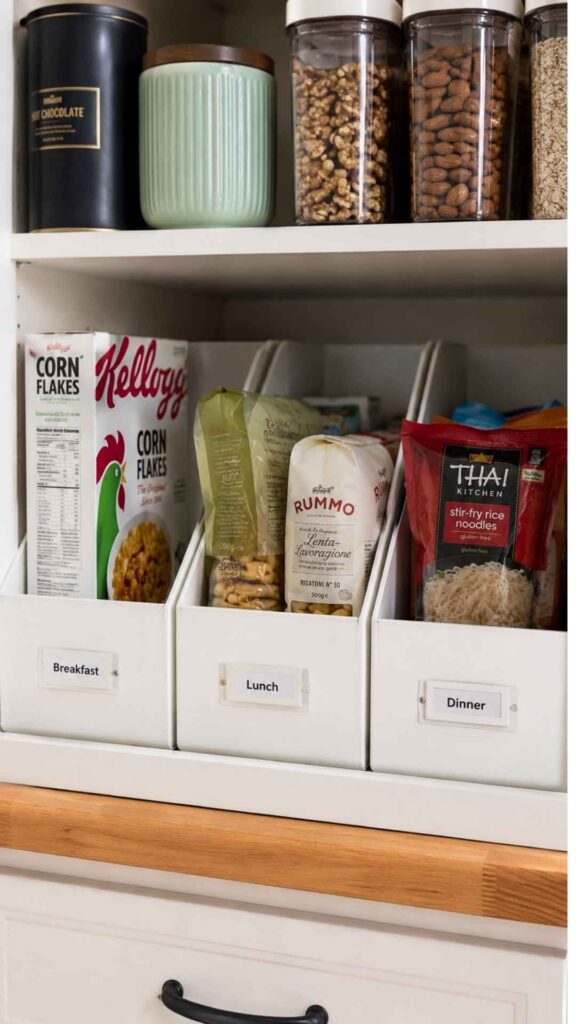
This arrangement makes it easier to find what you need without disturbing the rest of the cabinet. It also prevents half-used packets from disappearing at the back.
Before buying organizers, measure the cabinet’s depth, height, and width. Choose holders that fit comfortably and can be removed easily for cleaning. Among the most practical small kitchen storage ideas, this one works especially well because it requires no drilling or permanent installation.
2. Organize Food by Meal Instead of Product Type
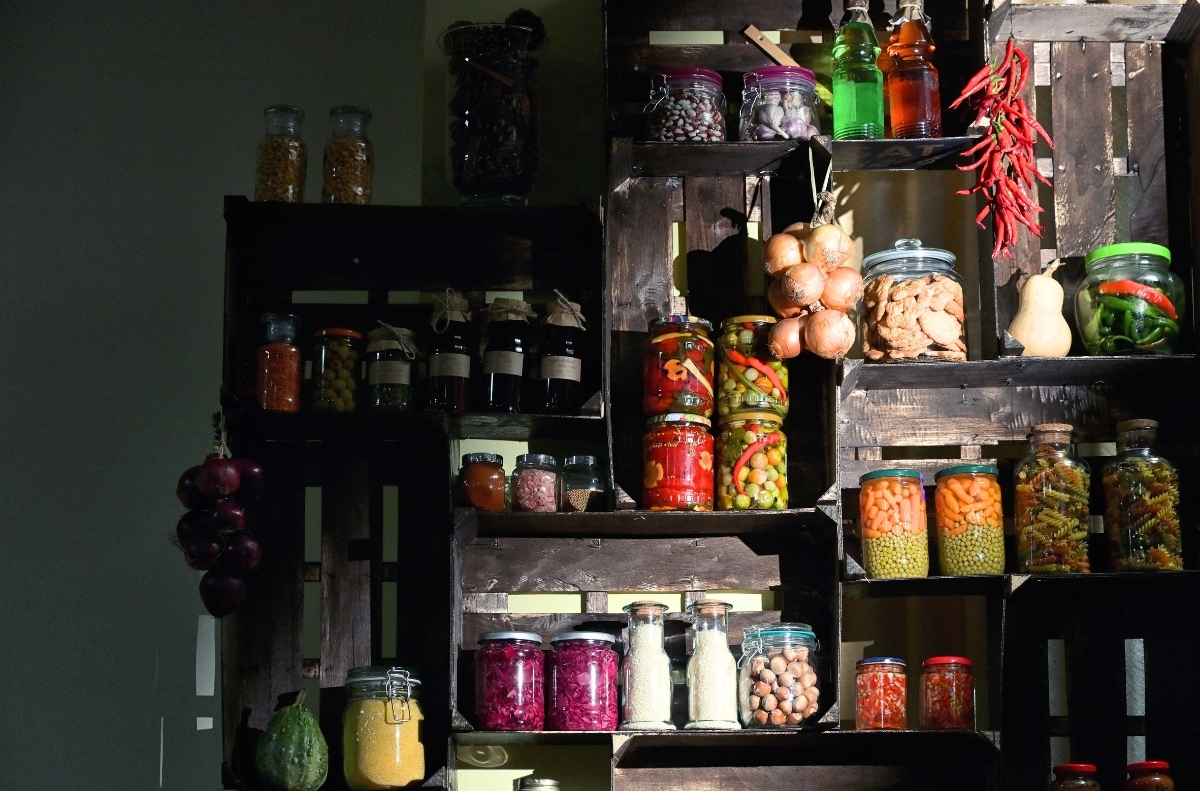
Many kitchens are organized by product category: lentils in one place, sauces in another, spices somewhere else, and snacks in a separate cabinet. Although this system may appear logical, it can become inconvenient when preparing one meal requires opening several doors and drawers.
Organizing food by meal or activity can make daily routines much faster. You might create a breakfast station with cereal, oats, tea, coffee, and spreads; a lunchbox section with snack packs, wraps, and reusable containers; a baking area; an evening snack corner; and a dinner zone for ingredients used most often.
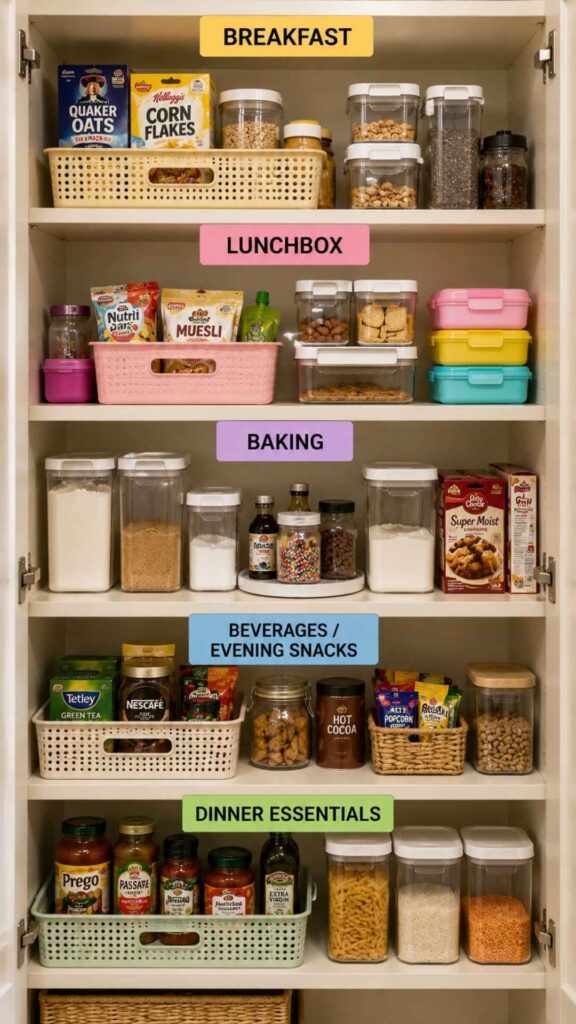
This method is particularly helpful for busy households, parents preparing school lunches, or anyone who regularly searches through several cabinets to complete one task.
There is no need to reorganize the entire kitchen at once. Start with the meal that creates the most clutter. A single breakfast or lunchbox zone can make a noticeable difference and is one of the easiest small kitchen storage ideas to test before making larger changes.
3. Add a Half-Depth Shelf Inside a Deep Cabinet
Deep cabinets often look spacious, but much of their capacity goes unused. Items are usually placed at the front, while the upper rear section remains empty or becomes difficult to reach.
A half-depth shelf riser can make that space usable. Place the riser toward the back of the cabinet to create a second level for smaller jars, tins, packets, or backup supplies. Because the shelf does not extend across the cabinet’s full depth, the front remains open for taller bottles and containers.
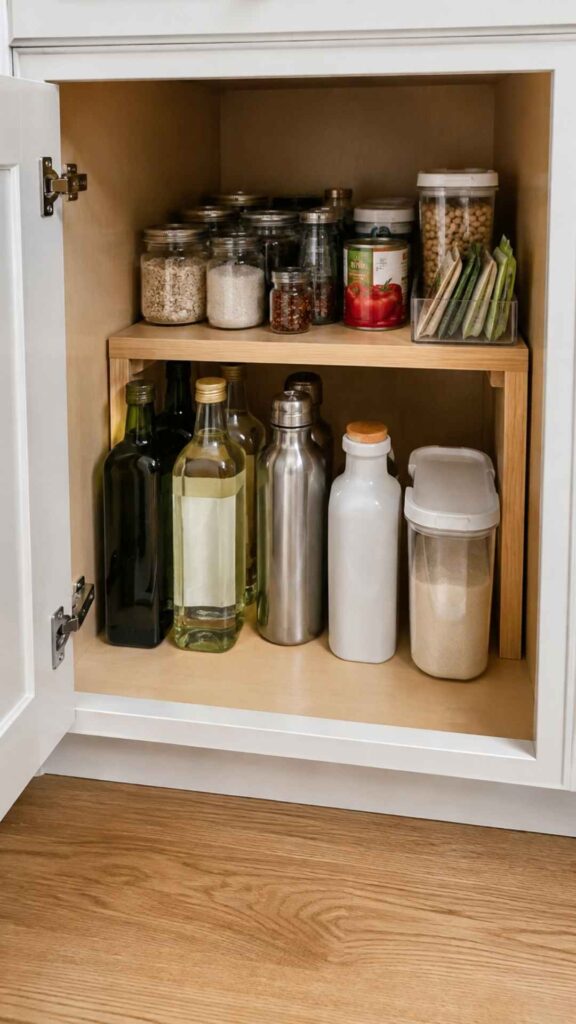
This layout improves visibility without making the cabinet feel crowded. It also prevents small items from becoming hidden behind larger ones.
Choose a sturdy wooden, metal, or acrylic riser that fits the cabinet properly. Avoid overloading it, and make sure the items stored on top can be reached safely. For renters, a freestanding shelf riser is preferable to a fixed shelf because it can be removed without damaging the cabinet. This makes it one of the most flexible small kitchen storage ideas for deep cabinets.
4. Turn One Deep Drawer into a Pantry Drawer
The lowest kitchen drawer is often reserved for pots, pans, or bulky utensils. However, if you already have another suitable place for cookware, that deep drawer can become a compact pantry.
Use adjustable dividers, shallow bins, or open containers to create sections. Store products upright whenever possible so their labels remain visible from above. Group items of similar heights together to make better use of the drawer’s depth.
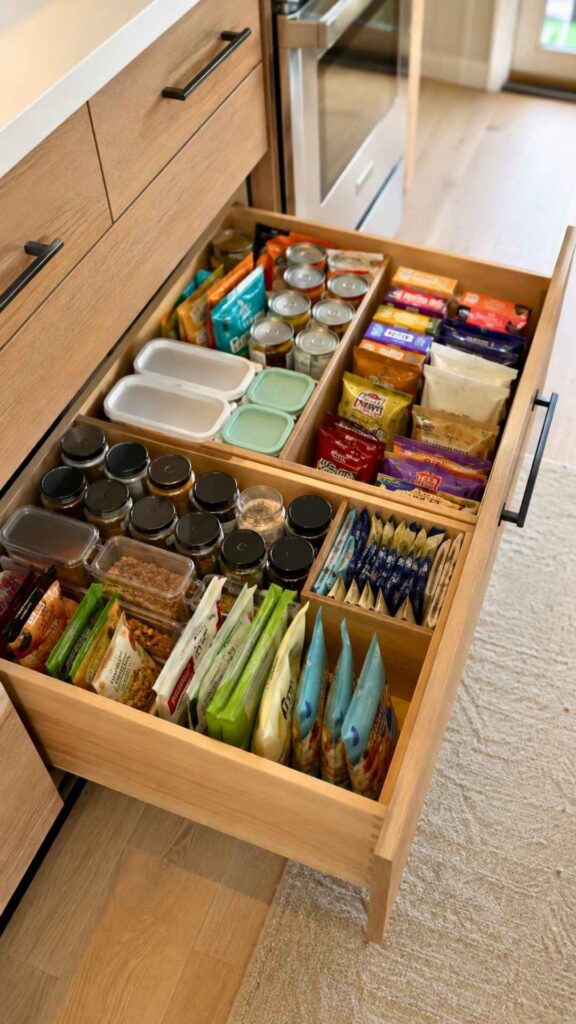
A top-down view makes it easier to spot packets, jars, and boxes before they expire. It also allows you to pull out the entire storage area instead of reaching into the back of a cabinet.
Always check the drawer’s weight capacity. Lightweight packets, tins, and plastic containers are usually suitable, while heavy glass bottles may strain weaker drawer runners. This is one of the most effective small kitchen storage ideas for kitchens with limited upper-cabinet space. It also creates a clear home for groceries that might otherwise remain on the countertop.
5. Use the Narrow Gap Beside the Refrigerator
A narrow gap between the refrigerator and the wall is often ignored because it seems too small to be useful. In many kitchens, however, it can hold a slim shelf, narrow rack, or custom storage strip.
Use this area for tea, baking supplies, unopened refill packets, lightweight containers, or products that do not need daily access. Add a front rail or raised edge so items cannot slide off. The unit should also be designed so that nothing can fall behind the refrigerator.
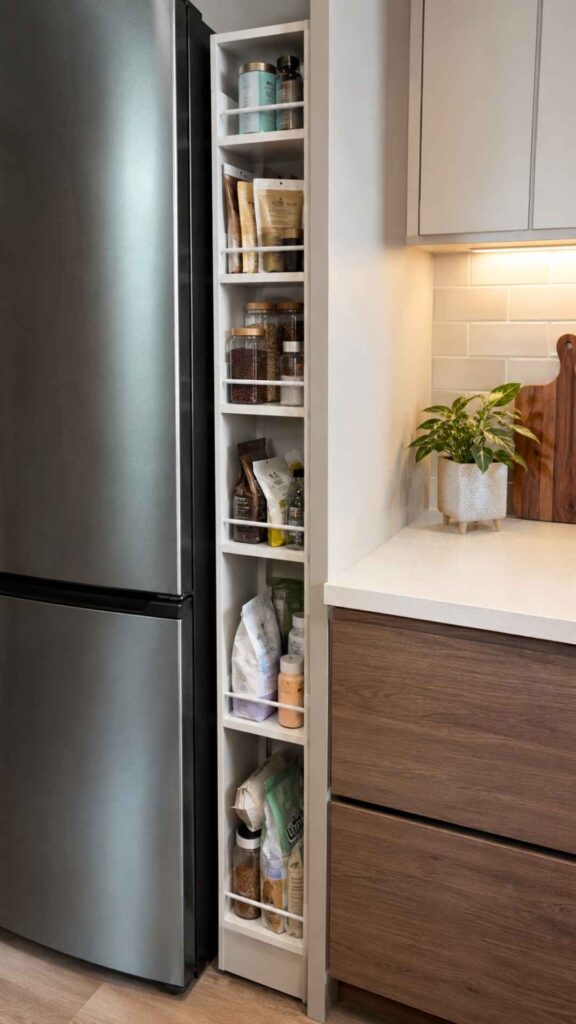
Before installing anything, check the refrigerator manufacturer’s ventilation and clearance requirements. Do not block airflow, and avoid storing heat-sensitive food too close to warm appliance surfaces.
A narrow built-in shelf can be more stable than a wheeled trolley, but a slim pull-out rack may work well when permanent installation is not possible. As with all small kitchen storage ideas, the final setup should remain easy to clean and should not interfere with appliance safety.
Used carefully, this gap can provide valuable food storage without reducing floor space. Among narrow-space small kitchen storage ideas, it is particularly useful because it turns an overlooked strip into functional storage.
6. Create a Narrow Gap Beside the Refrigerator
A pantry does not need to be as deep as a standard kitchen cabinet. If you have an unused wall, a series of shallow shelves or narrow picture ledges can create useful storage without making the room feel cramped.
Use them for small jars, tea, coffee, sealed dry goods, sauces, or lightweight backup supplies. Keep frequently used items at eye level and less frequently used items higher up.
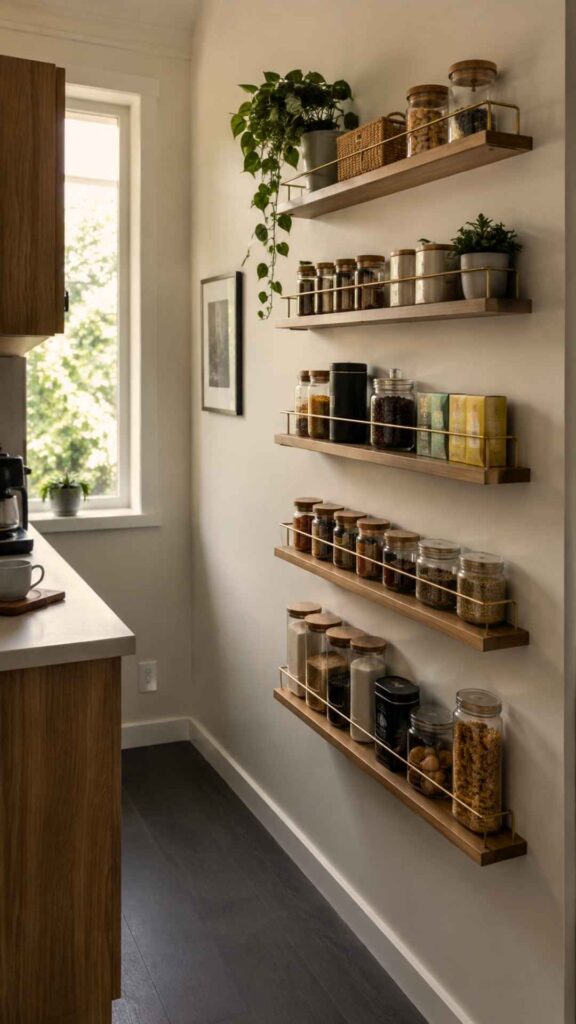
Shelf depth is important. Deep shelves may reduce walking space and make a small kitchen feel tighter. Shallow shelves keep everything visible while limiting the temptation to create multiple hidden rows.
Install a front rail to prevent jars and packets from falling. Avoid placing food storage directly above the sink, hob, or kettle, where steam, grease, and heat may affect the contents. These small kitchen storage ideas work best when wall space is available but floor space is limited.
7. Use Under-Shelf Baskets for Lightweight Food
The empty space directly beneath a cabinet shelf is easy to overlook. Under-shelf baskets make use of this gap without requiring another cabinet or permanent installation.
They are suitable for lightweight items such as bread, tortillas, snack packets, reusable grocery bags, garlic, or onions. Choose ventilated baskets for produce so that air can circulate.
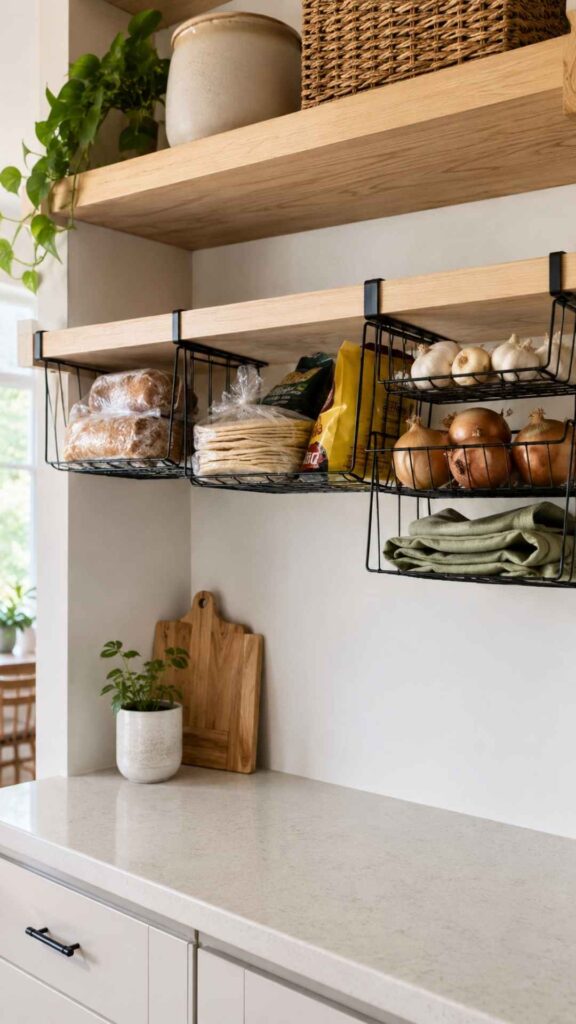
Before buying, measure the shelf thickness and the available clearance beneath it. The basket should slide on securely without preventing the cabinet door from closing. It should also leave enough space above the countertop for food preparation and small appliances.
Avoid storing cans, glass jars, or other heavy items in hanging baskets. Keep produce away from steam and cooking heat. When used correctly, under-shelf baskets are simple small kitchen storage ideas that turn unused vertical space into accessible storage.
8. Build an Above-Cabinet Refill Zone
The gap between upper cabinets and the ceiling often becomes a resting place for rarely used appliances, random containers, or decorative clutter. It can work more effectively as a controlled backup-storage zone.
Use matching, lightweight bins with handles for unopened pasta, cereal, paper goods, snack refills, or other bulk supplies. Keep one category in each bin and label it clearly.
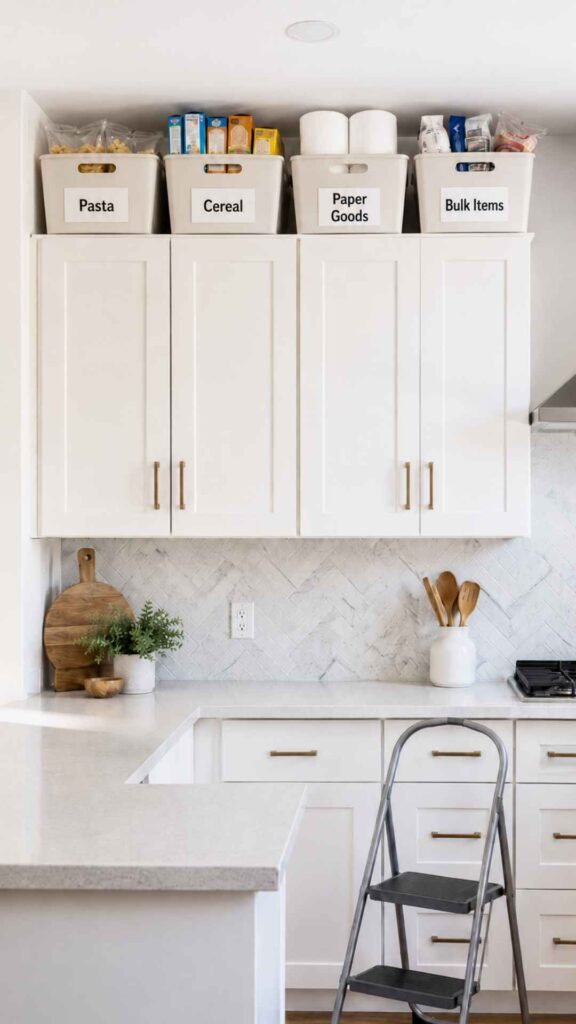
Store only items that are not needed every day. Open packets should remain in lower cabinets or sealed containers because the tops of cabinets can collect dust. Keep a stable folding step stool nearby so that the bins can be lifted down safely.
A useful system is “one downstairs, one backup upstairs.” Keep one active container within easy reach and store only its replacement above. When the everyday container is empty, refill it from the backup zone.
This method prevents overstocking and turns an awkward area into purposeful storage. It is one of the most useful small kitchen storage ideas for households that buy groceries in bulk.
9. Fix a Blind Corner with a Two-Level Turntable
Corner cabinets are often deep, dark, and difficult to use. Items placed at the back become invisible, and retrieving one bottle may require removing everything stored in front of it.
A two-level or multi-tier turntable can make the entire corner easier to access. Arrange frequently used items on the most convenient section and rotate the organizer instead of reaching into the back.
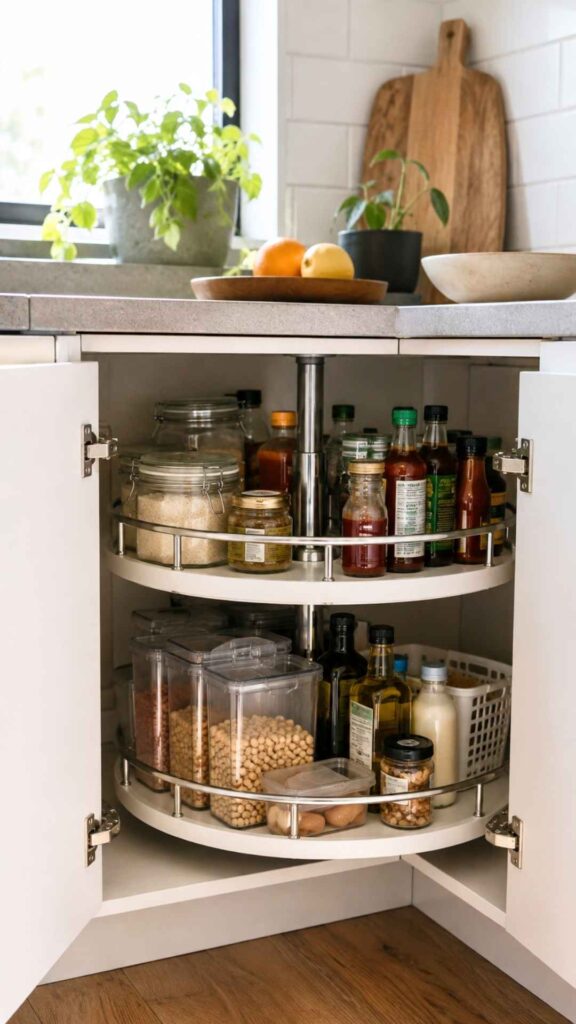
Place heavier bottles and larger containers on the lower tier. Keep lighter packets, jars, and smaller items on top. This improves stability and helps the organizer rotate smoothly.
Measure the cabinet opening as well as the internal width and depth before purchasing a turntable. A large organizer is not useful if it cannot pass through the cabinet door. For awkward cabinets, this is one of the most practical small kitchen storage ideas because it improves both visibility and access without changing the cabinet structure.
10. Create a Furniture-Style Pantry Corner
An unused corner of the kitchen or dining area can become a pantry with the right piece of furniture. Instead of choosing a unit that looks like an extra kitchen cabinet, consider a freestanding hutch, bookcase, sideboard, or narrow shelving unit that complements the room.
Store everyday snacks, dry fruits, tea, or breakfast supplies in the middle section, where they are easy to reach. Use the lower shelves for heavier items and the top shelves for lightweight products that are needed less often.
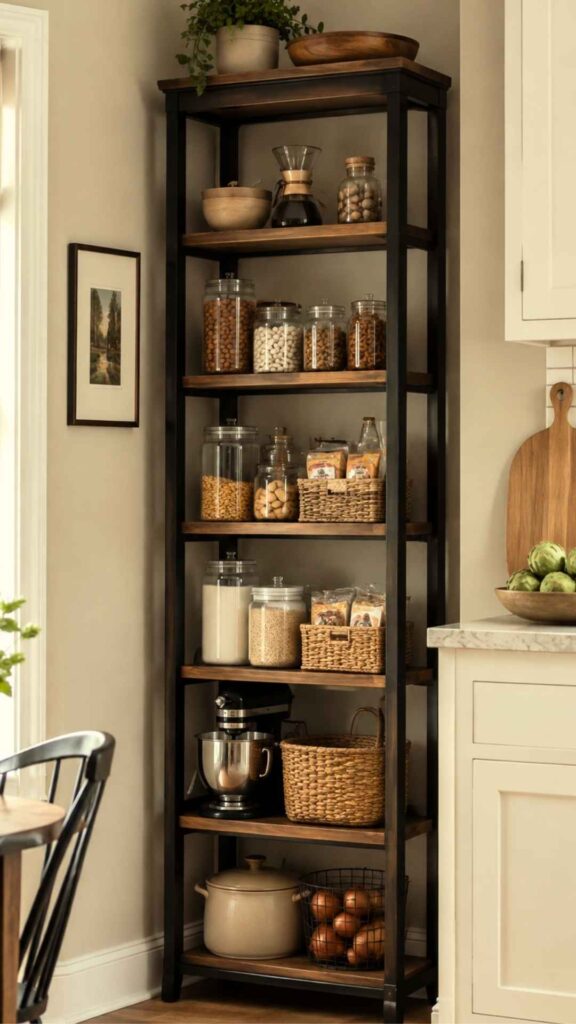
Baskets, jars, and trays can help the unit look intentional rather than cluttered. The strongest small kitchen storage ideas combine practical access with a visually calm arrangement. Keep the unit’s color, material, or finish consistent with the surrounding furniture so that the pantry blends naturally into the room.
This approach creates the appearance and function of a built-in pantry without renovation. It also shows how small kitchen storage ideas can extend beyond the kitchen cabinets themselves. This solution is especially useful in open-plan homes where the kitchen and dining area share the same space.
How to Choose Among These Small Kitchen Storage Ideas
The best solution depends on where your kitchen currently has unused or poorly organized space.
- If you have one unused cabinet, start with Ideas 1, 2, or 3.
- If you have a deep drawer, choose Idea 4.
- If there is a narrow gap beside the refrigerator, consider Idea 5.
- If you have an empty wall, try Idea 6.
- If there is unused space beneath a shelf, use Idea 7.
- If the tops of your cabinets are empty, create the refill zone in Idea 8.
- If you have an awkward corner cabinet, choose Idea 9.
- If there is an unused dining or kitchen corner, try Idea 10.
Do not choose a solution simply because it looks attractive online. Measure the available space, consider how often the stored items will be used, and make sure the storage method is safe and easy to maintain.
The most successful small kitchen storage ideas solve a specific daily problem. Begin with the area where groceries are most likely to pile up, disappear, or create inconvenience.
Final Thoughts
A pantry is useful, but it is not essential. You can keep a small kitchen organized when frequently used items are within easy reach, backup supplies have a defined place, and every product is visible and accessible.
There should also be a clear space for incoming groceries so that they do not remain on the countertop or become mixed with utensils and existing supplies. A simple restocking routine can prevent forgotten packets, duplicate purchases, and expired food.
Do not try to implement every system at once. The most practical small kitchen storage ideas are easier to maintain when introduced gradually. Focus first on the cabinet, drawer, wall, or corner that causes the most difficulty. Once that area works well, move on to the next.
The best small kitchen storage ideas are not necessarily the most elaborate ones. They are the systems that fit your habits, make food easier to find, and keep the kitchen calm and functional. When every grocery item has a defined place, even a compact kitchen can feel spacious, organized, and easy to work in.