Discover 10 practical small closet organization ideas that make better use of hanging space, shelves, corners, and overlooked gaps without adding unnecessary storage products.
A small closet can quickly become frustrating. You may manage to fit all your clothes inside, but retrieving a single shirt can mean moving ten hangers out of the way. Stacks of sweaters begin to lean, while some garments get pushed so far back that they seem to disappear entirely.

The first impulse is often to buy another basket, add a cabinet, or install more hanging organizers and hooks. But a better question is: do you truly lack space, or is it poorly arranged for the clothes you own? This is where small closet organization ideas can make a real difference.
A dress needs full vertical height, while a folded T-shirt needs very little. Sweaters spread sideways, and folded trousers take only a few inches of shelf space, yet many closets give roughly the same room to everything. The problem is not always the size of the closet; often, it is the arrangement.
1. Small Closet Organization Ideas Can Start With a Clothing-Length Map
Instead of looking at how full the closet is, pay attention to the different lengths of your hanging clothes. Shirts end higher, jackets hang lower, and dresses may reach almost to the floor.
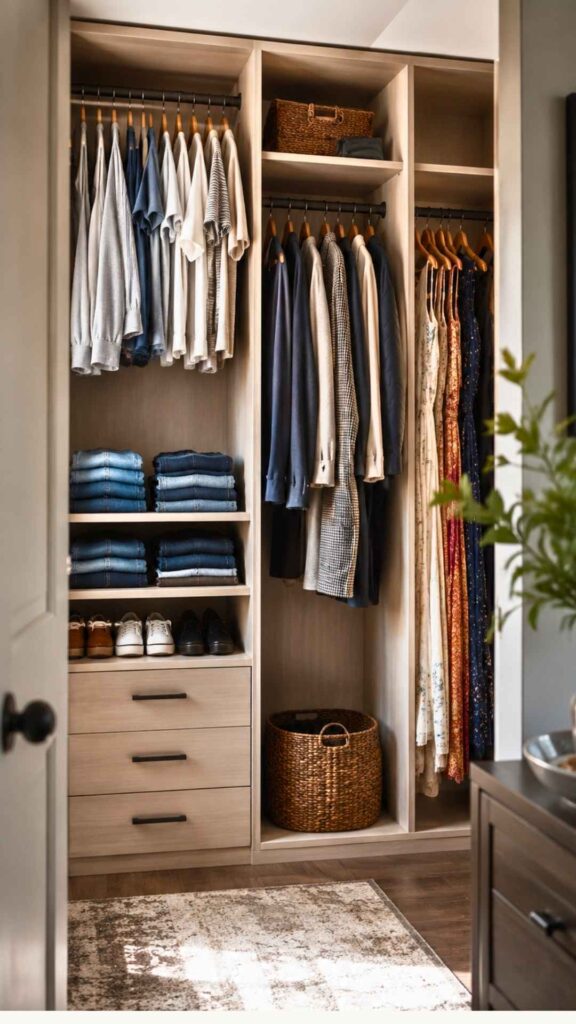
A single hanging rod often turns the entire closet into full-length storage, even when only a few garments need that much vertical space. Group shirts together, keep medium-length pieces on one side, and give long dresses or coats their own section.
This opens useful room underneath shorter garments for folded jeans, drawers, or compact shelves. Among the most practical small closet organization ideas, measuring the clothes themselves can be more useful than measuring only the closet.
2. Stagger Hangers Instead of Packing Them Tighter
The shoulders are usually the widest part of a shirt or jacket. When every hanger sits at exactly the same height, those shoulders press against one another and compete for the same horizontal space.
A small hanger extender can lower every other garment slightly, allowing the shoulders to overlap rather than collide.
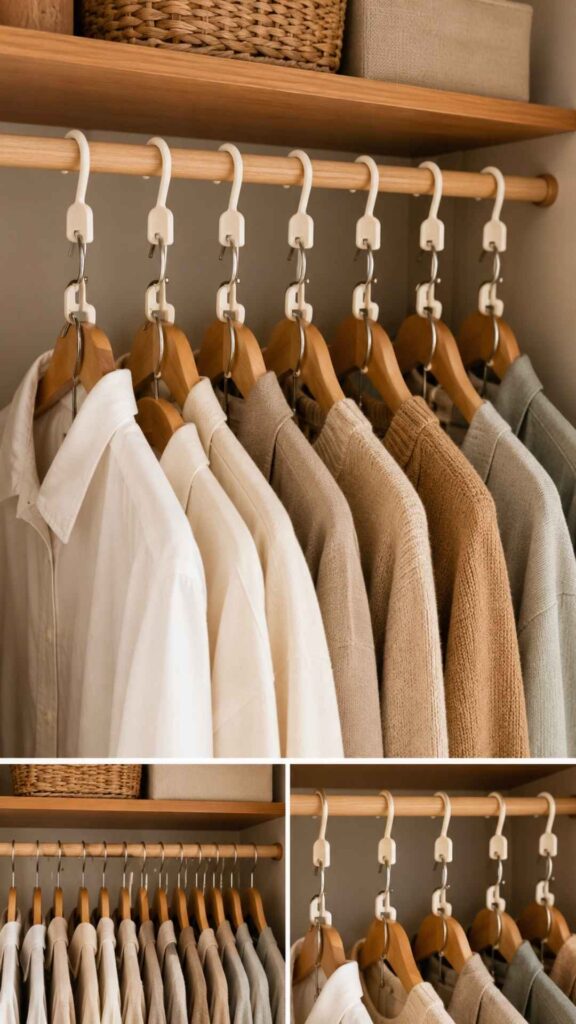
This will not double your closet’s capacity, but it can make a noticeable difference on an overcrowded rail. Some of the most effective small closet organization ideas involve repositioning what you already own instead of adding more storage products.
3. Give Stagger Hangers Their Own Narrow Lane
A few long garments can dictate the entire closet layout. Owning four long dresses, for example, does not mean every section needs to accommodate full-length hanging.
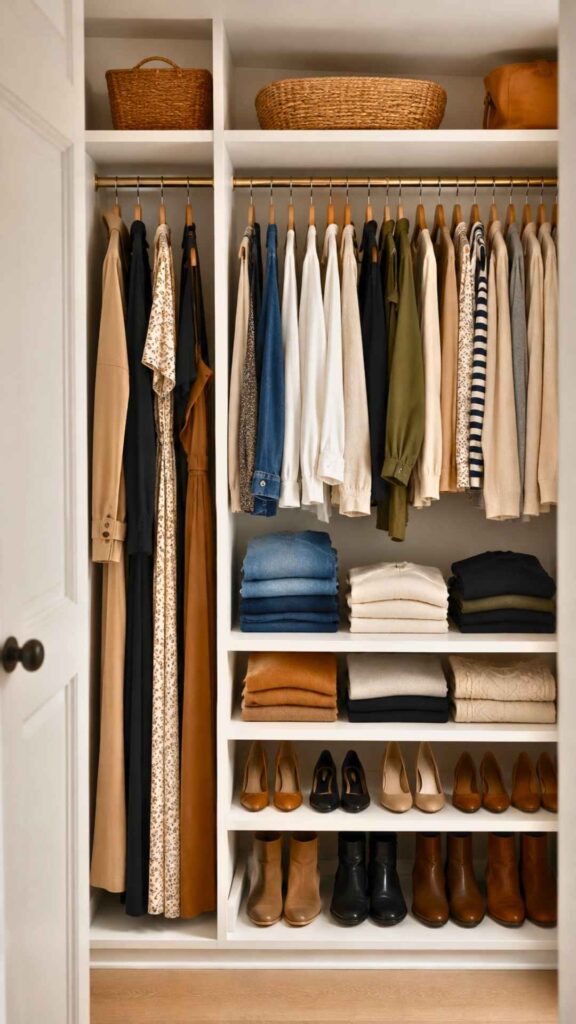
Group long coats, dresses, and jumpsuits into one narrow lane so the rest of the closet can work harder for shorter clothes. The space beneath shirts and jackets can then hold folded clothing, drawers, shelves, or shoes.
When considering small closet organization ideas, ask how much of the closet genuinely needs full vertical clearance. The answer is often much less than expected.
4. Use the Wall Behind Hanging Clothes
A closet can look full while the back wall remains unused. If there is enough clearance behind hanging shirts, shallow fabric pockets can provide discreet storage for thermals, swimwear, or other small folded garments.
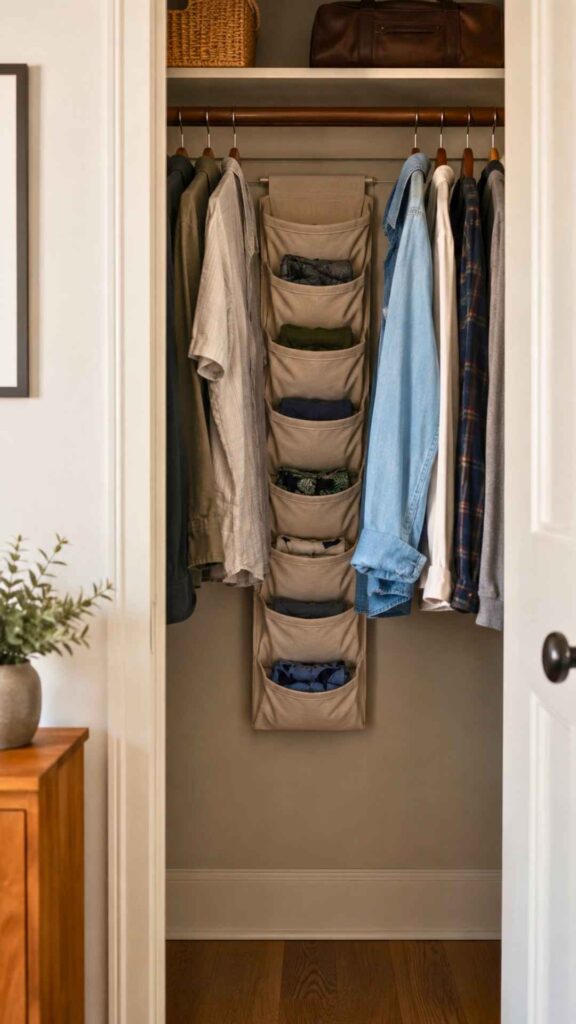
The key is to keep the pockets flat. If they project too far, they will push clothes forward and make the closet harder to use.
Good storage should add capacity without making everyday access more awkward. In this case, the extra space stays almost invisible from the front.
5. Turn Narrow Side Walls Into Clothing Shelves
The slim side walls beside a closet opening are often dismissed as useless because standard shelves will not fit. Shallow shelves, however, can work well in these awkward strips of space.
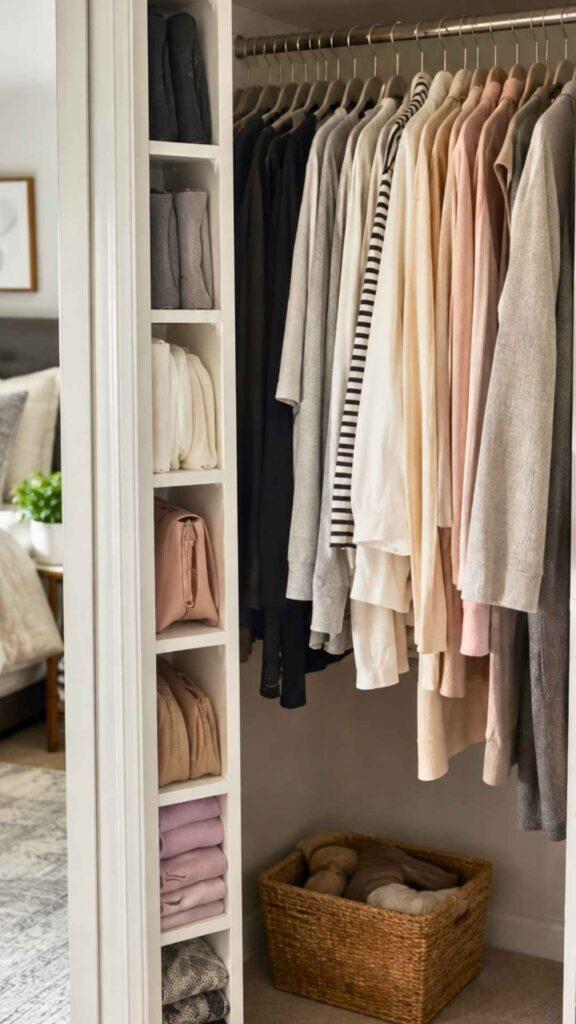
They are suitable for leggings, workout tops, sleepwear, small handbags, or vertically folded shirts. A small closet does not always suffer from a total lack of room; sometimes, space comes in inconvenient shapes.
The strongest small closet organization ideas make those awkward areas useful without crowding the main storage zones.
6. Build a Skinny Trouser Zone
If trousers make up a large part of your wardrobe, a pull-out trouser rack can use a narrow section efficiently.
Instead of placing it parallel to the main hanging rail, it can be fitted beside a shelving unit where multiple pairs can be stored within a compact footprint. Before installing one, count how many trousers you actually own.
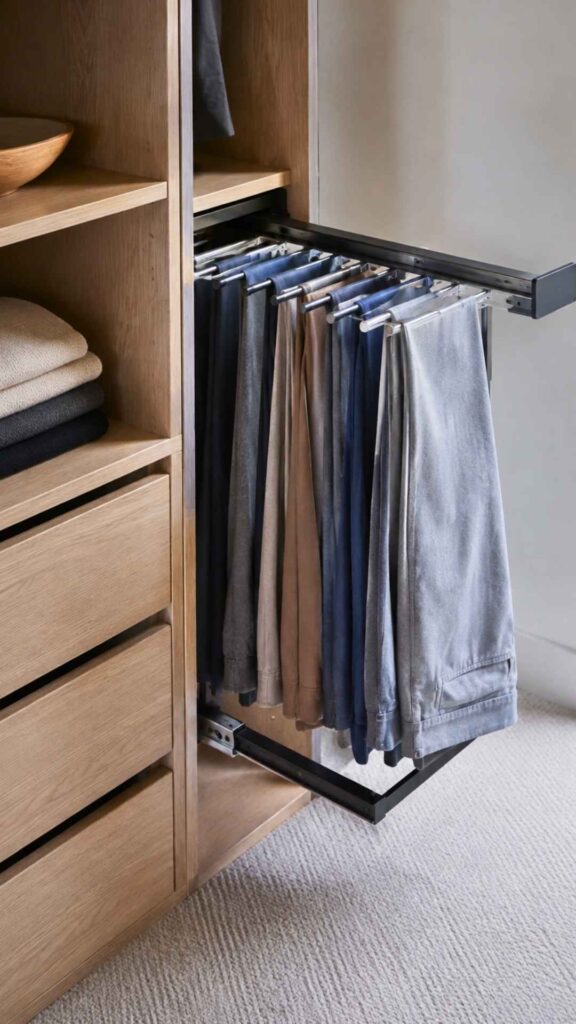
That small step matters because the closet should reflect your wardrobe rather than follow a generic storage plan. Good storage works best when it responds to the specific types and quantities of clothing you actually use.
7. Look Above the Top Shelf for Small Closet Organization Ideas
Storage does not necessarily end at the closet’s top shelf. There is often unused space between that shelf and the ceiling, and it can be valuable for soft, lightweight items.
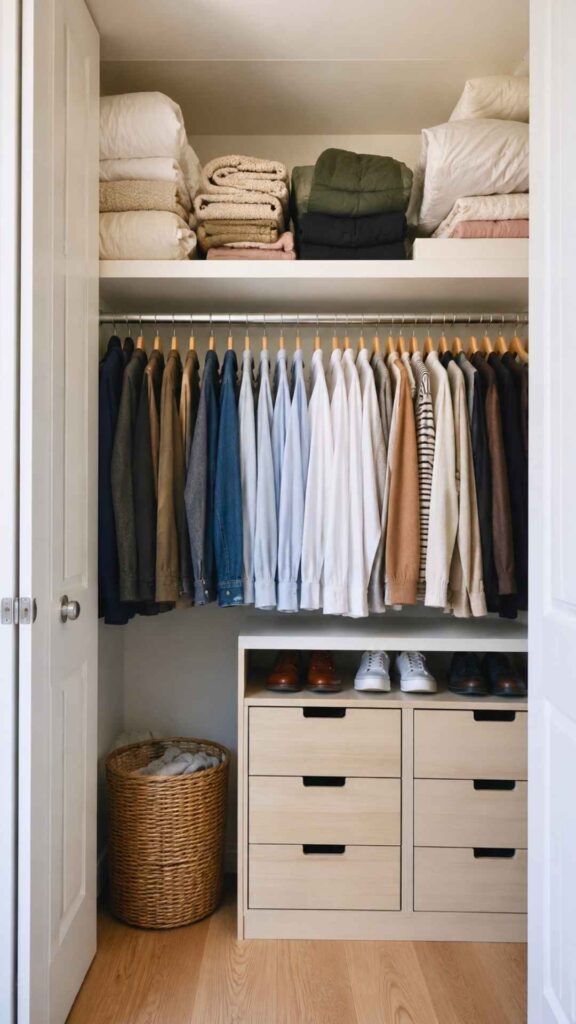
Spare winter bedding, lightweight jackets, or occasion wear can be stored there without taking over easier-to-reach areas. Everyday T-shirts, however, would be inconvenient in such a high spot.
Effective small closet organization ideas depend on matching each storage location to how often an item is used. Frequently worn clothes should remain accessible, while rarely used pieces can occupy less convenient spaces.
8. Check What Is Hiding Beneath Built-Ins
If your closet has built-in drawers or shelving, look at the base. A solid-looking plinth may conceal unused depth beneath the unit.
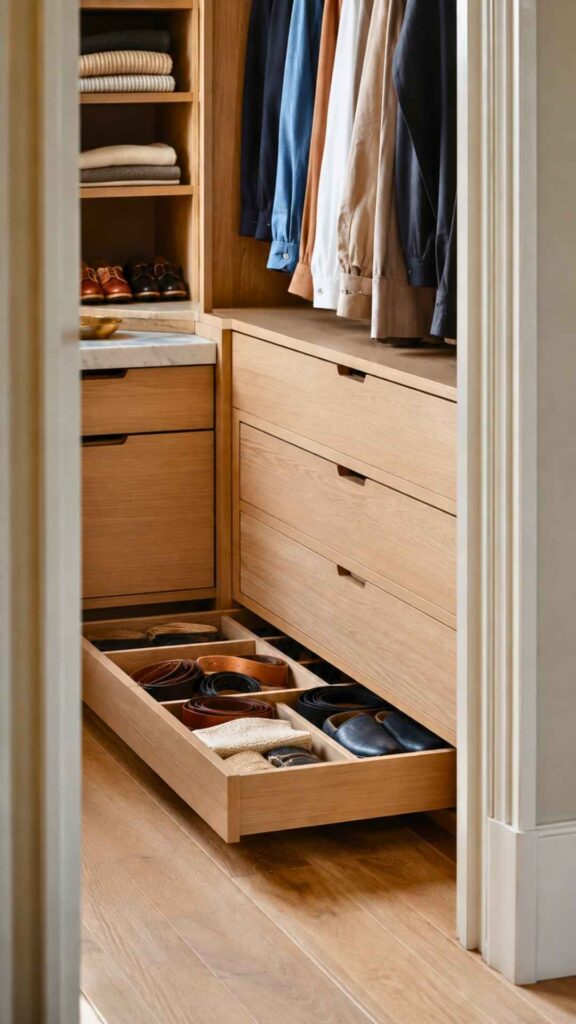
During a renovation, that area can sometimes be converted into a shallow pull-out drawer. It may not be deep enough for sweaters, but it can hold belts, slippers, or flat accessories.
Not every blank panel hides usable storage, so it is important to check rather than assume. Some small closet organization ideas are simply about recognizing space that was already there but never made accessible.
9. Stop Letting Sweaters Expand Sideways
A stack of sweaters may look tidy at first, but removing one from the middle can cause the whole pile to collapse. Rather than building a tall stack, divide the shelf into smaller horizontal sections.
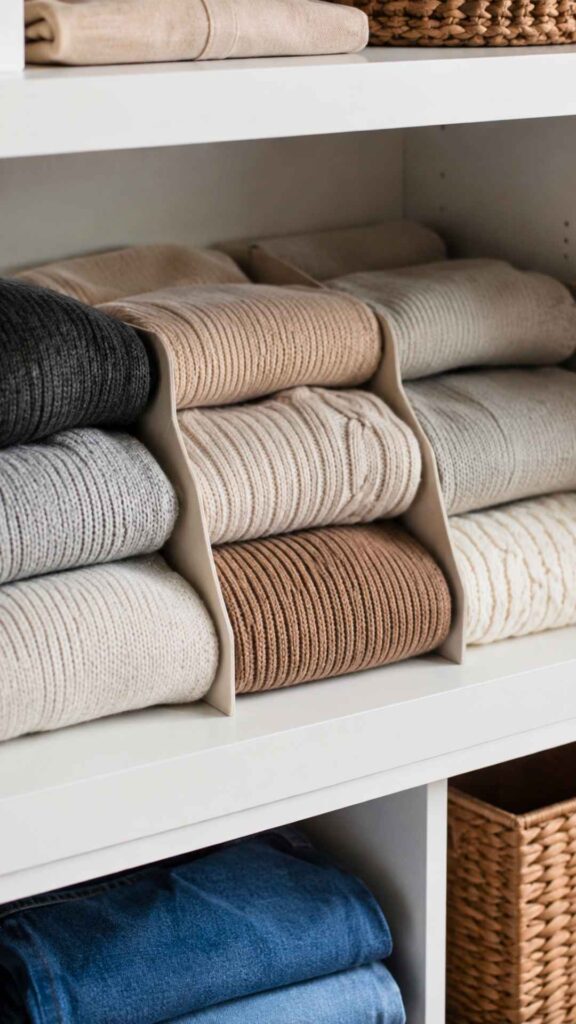
Flexible dividers or soft straps can keep knitwear from spreading sideways without compressing it.
The goal is not to squeeze garments into less space; it is to stop them from taking over more space than they need. Clear boundaries often work better than tighter packing.
10. Use the Tiny Gap Beside the Door Frame
A narrow strip beside the closet door may seem too small to matter, but even a few inches can hold a vertical row of hooks or clips. Belts, small handbags, and accessories can hang there instead of cluttering drawers.
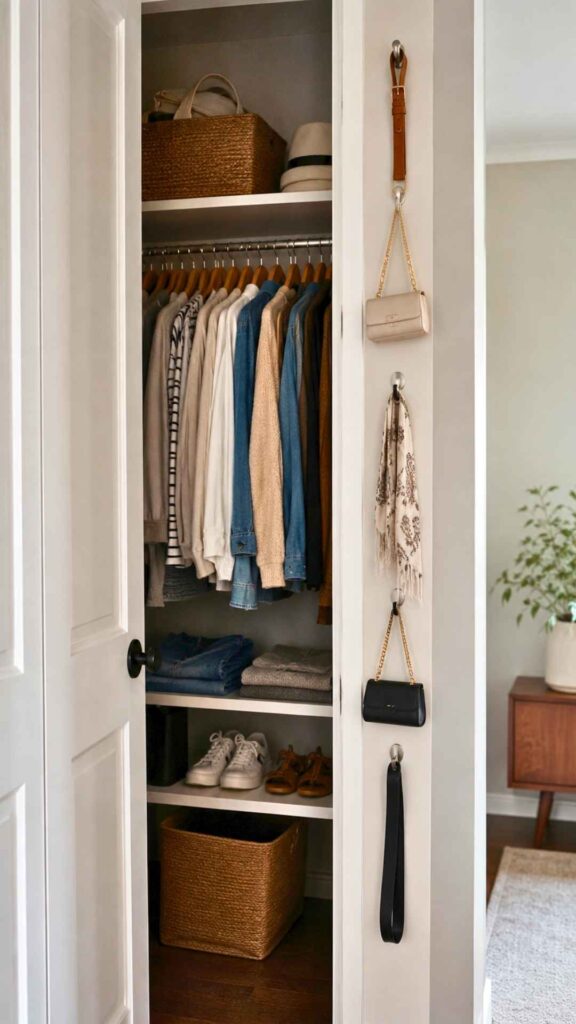
These items take up little volume yet can consume valuable drawer space when stored inefficiently. Moving them into these overlooked gaps leaves prime storage areas available for bulkier clothing.
Smart small closet organization ideas use awkward spaces for small items and reserve the main shelves, rails, and drawers for larger pieces.
Final Thoughts on Small Closet Organization Ideas
The best small closet organization ideas do not always begin with buying more baskets, hangers, or organizers. Often, they start with looking more carefully at the space you already have.
Check beneath shirts, behind hanging garments, along narrow side walls, and beside the door frame. Notice where sweaters spread, where long dresses consume unnecessary vertical space, and where rarely worn clothes occupy the easiest-to-reach areas.
Then consider your daily routine: where do your sweaters go, which clothes do you reach for first each morning, and which part of the closet causes the most frustration? A small closet does not need to look like a magazine spread.
It simply needs to make your clothes easy to see, retrieve, and put back without a struggle. That may be the clearest definition of a well-organized small closet.